The narrative of construction is too often confined to temperate, forgiving landscapes. This is a profound misrepresentation of human ambition. We build not only where it is easy, but where it is essential: in the frigid desolation of mountain ranges, within the searing crucibles of deserts, atop unstable permafrost, and deep within urban labyrinths where space is a forgotten luxury. In these theatres of extremity, the conventional playbook fails. Here, the stationary concrete pump evolves from a mere piece of equipment into the linchpin of possibility. Its successful deployment is not a matter of simple logistics; it is a testament to rigorous adaptation, a battle fought against physics and environment. To view these machines as simple conveyors of material is a critical failure of imagination. In unique environments, they become engineered life-support systems for the project itself, and their configuration dictates the very structural destiny of the pour.
The Crucible of Climate: Engineering Against Thermal Extremes
Concrete is a material with a biological-like sensitivity to temperature, and stationary pumps are the vessels through which this sensitivity must be controlled. In sub-zero environments, the challenge is a seductive trap. The threat of freezing is obvious, but the more insidious enemy is thermal differential. Simply heating the mix is a naive and dangerous solution. It can create a false sense of security while setting the stage for catastrophic early-age freezing or delayed ettringite formation. The correct approach is a holistic encapsulation of the entire delivery system. This means jacketed, insulated pipeline runs that maintain a consistent thermal envelope, complemented by dedicated heating elements at critical junctures like the pump hopper and gate valve. The hydraulic fluid itself must be of a Arctic-grade viscosity, and electric trace heating on the pump’s core hydraulic manifold is not an optional extra—it is a fundamental requirement for mechanical survival.
Conversely, in arid, high-temperature environments, the battle is against rapid hydration and plastic shrinkage. The line pump’s role shifts from insulator to cooling agent. Chilled mixing water and liquid nitrogen injection systems become vital, but their efficacy is nullified if the concrete cooks within the pipeline. Here, pipeline management is about solar mitigation and velocity. Lines must be shaded, painted reflective white, or even buried. The pumping sequence must be orchestrated to ensure a consistent, rapid flow, preventing mix from stagnating and seizing in the line. The pump’s own cooling systems must be drastically oversized; standard radiators will capitulate to the ambient thermal onslaught, leading to overheated hydraulics and catastrophic pressure loss at the most critical moment.
The Geometry of Adversity: Confined, Elevated, and Remote Sites
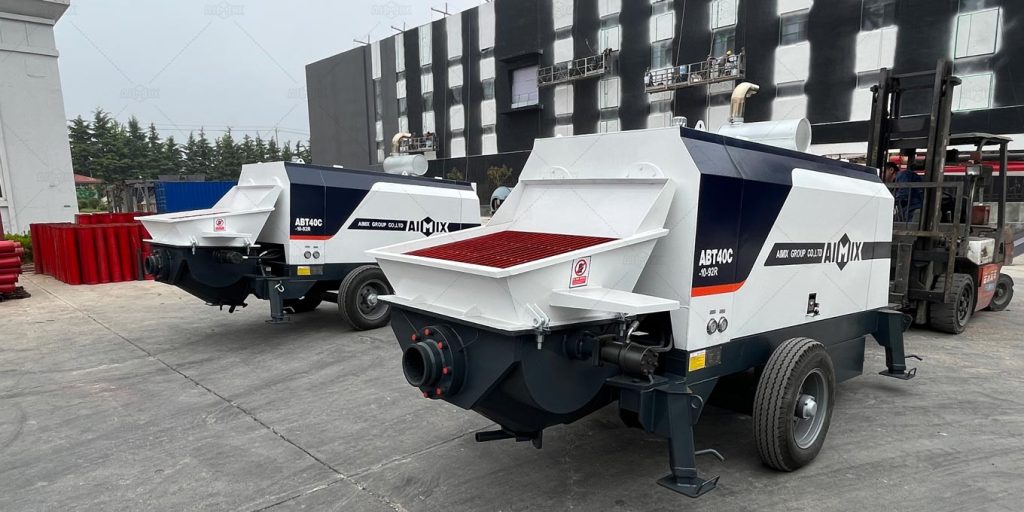
Extremity is not defined by climate alone. It is often a function of pure spatial imposition. Urban infill projects, tunnel linings, and high-rise cores present a distinct spatial tyranny. There is no room for the sprawling footprint of a truck-mounted pump’s outriggers. The stationary concrete pump in Saudi Arabia, with its compact ground-level footprint, becomes the only viable protagonist. Its triumph, however, hinges on meticulous pipeline design in three dimensions. Complex 90-degree bends are not merely directional changes; they are pressure sinks and wear points that must be minimized through creative routing. The use of high-pressure, wear-resistant line pipe with specialized elbow guards is non-negotiable. Every vertical ascent is a fight against gravity and material segregation, demanding precise slump control and often, the strategic placement of a pressure-relieving horizontal leg to mitigate the “standing column” effect that can crush aggregate at the pump’s piston.
Remote locations present a logistical diabolical. A pump failure on a wind farm atop a mountainous ridge or at a remote mining site is not an inconvenience; it is a project-killing event. Here, the pump’s configuration prioritizes redundancy and robustness above all else. This necessitates modular designs that can be skid-mounted and transported in sections. Critical spare parts—seals, cutting rings, main relief valves—must be integral to the initial mobilization, not an afterthought. The pump’s design philosophy must embrace serviceability in isolation, with easy access to key components and common tooling. The electrical system must be adaptable to unpredictable local grid power or be paired with a dedicated, oversized generator, treating power quality not as a given but as a variable to be conquered.
The Material Metamorphosis: Pumping Specialized Mix Designs
The environment dictates the material, and the material dictates the pump’s parameters. This is the irreducible equation. Concrete trailer pumps in these contexts are not handling standard 25MPa mixes. They are the conduits for highly engineered, often proprietary concoctions. Self-consolidating concrete (SCC), with its low viscosity and high flowability, seems pump-friendly but demands exceptionally smooth pipeline interiors and consistent pressure to prevent segregation. Lightweight concrete introduces a different challenge—its variable aggregate buoyancy can lead to differential friction within the line and unpredictable pressure spikes. The pump’s control system must be sophisticated enough to adapt its stroke rate and pressure output in real-time to these fluid dynamics.
Even more demanding are the growing class of fibrous and ultra-high-performance concretes (UHPC). Steel or synthetic fibers pose a direct threat to the pump’s very anatomy, with the potential to ball up at the S-tube valve, clogging the system catastrophically. This demands specialized valve systems, often rock-valve or ball-valve designs, that can shear through the fibers without hesitation. UHPC, with its extremely low water-to-cement ratio and dense matrix, requires immense, sustained pumping pressure. This places extraordinary stress on every component, from the hydraulic system’s stability to the pipe wall’s yield strength. The pump is no longer a passive tool; it must be a co-engineered partner to the mix design, its capabilities and limits defining the very composition of the concrete it will place. To ignore this symbiotic relationship is to guarantee failure at the moment of truth.